
Based on Gaoqi's years of practical experience in label printing, this article comprehensively analyzes the three mainstream label printing processes of digital, flexographic, and embossed printing from five dimensions: "process principles, core advantages, shortcomings, applicable scenarios, and Gaoqi practical cases", allowing everyone to clearly grasp the core characteristics of each process, accurately match their own needs, and demonstrate Gaoqi's technical advantages in various process fields.
(1) Digital label printing: a preferred solution for small batch and personalized printing
Digital label printing is a new label printing process developed based on digital technology, which does not require plate making or on-demand printing, breaking the traditional "batch threshold" of label printing and becoming the core choice for small batch and personalized label printing. It is also one of the key process directions optimized by Gaoqi.
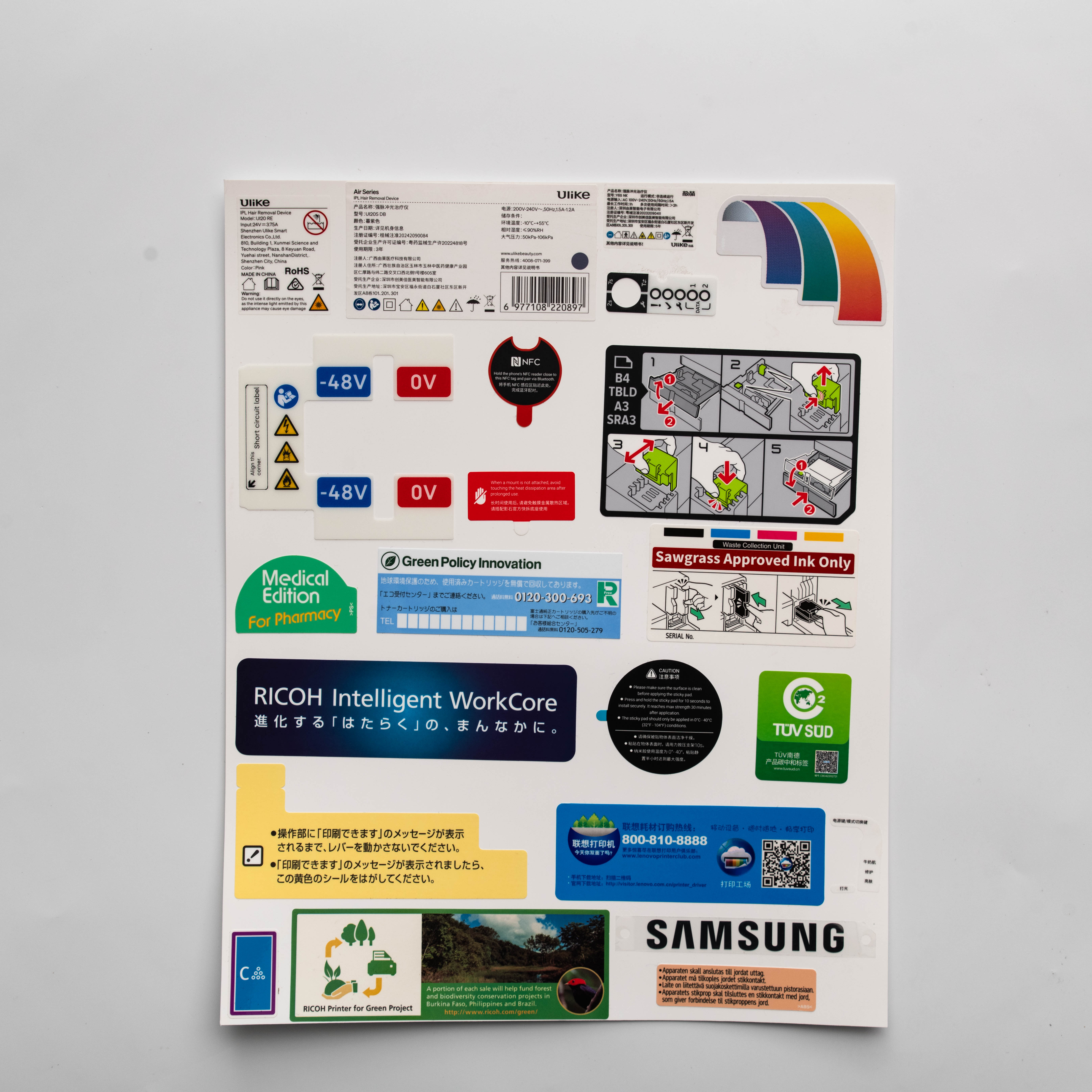
1. Process principle: There is no need to make a printing plate. The designed label file (such as PDF, AI format) is input into the digital printing equipment. The equipment uses inkjet or laser technology to directly transfer ink to the label substrate, completing the integrated process of printing, die-cutting, laminating, etc. The entire process is digitally controlled and can adjust graphics, text, and batch in real time.
2. Core advantages: ① No plate making cost, high cost-effectiveness for small batch (100-5000 copies) printing, avoiding waste in traditional plate making processes; ② Short delivery cycle, can be shipped on the same day at the earliest, suitable for urgent orders and trial product labels; ③ Personalized customization is flexible and can achieve "one item, one code" and "batch variable graphics and text" (such as tracing source code, QR code labels); ④ High printing accuracy, clear edges of text and patterns, good color reproduction, suitable for fine label requirements.
3. Shortcoming: The printing cost for large quantities (over 10000 copies) is higher than that of flexographic and embossed printing; The weather resistance and wear resistance of some digital inks are slightly inferior to traditional inks, making them unsuitable for long-term outdoor use; Although the range of compatible substrates is wide, some special substrates (such as thick aluminum foil) have poor printing effects.
4. Applicable scenarios: small batch trial sales labels, personalized customized labels (such as gift labels, customized packaging labels), variable code labels (such as product traceability labels, anti-counterfeiting labels), emergency order labels, suitable for industries including food, cosmetics, electronics, gifts, etc.
Gaoqi practical case: A food enterprise needs to customize 1000 trial sales product labels, requiring delivery within 3 days with variable traceability source code. Gaoqi adopts digital label printing technology, which does not require plate making, and quickly completes the integrated process of design, printing, and die-cutting. Delivery is made 1 day in advance, with uniform label colors and clear traceability source code, while controlling the cost of small batch printing and gaining customer recognition.
(2) Flexographic label printing: the mainstream choice for medium to large-scale, environmentally friendly and efficient printing
Flexographic label printing is one of the mainstream processes in the current label printing industry. With the advantages of environmental protection, efficiency, and adaptability to multiple substrates, it occupies a dominant position in the medium to large batch label printing market. Gaoqi has a complete set of flexographic printing equipment that can adapt to various medium to large batch label printing needs.
1. Process principle: To produce flexible printing plates (usually rubber or resin printing plates), environmentally friendly water-based ink is evenly transferred to the graphic and textual parts of the plate through a mesh roller, and then transferred to the label substrate through light pressure to complete printing. It can be combined with subsequent processes such as lamination, die-cutting, and hot stamping to achieve integrated production.
2. Core advantages: ① Strong environmental friendliness, using water-based ink, no odor, no volatile harmful substances, in line with environmental standards in industries such as food and cosmetics; ② Widely adaptable substrates, capable of printing various types of label substrates such as paper, film, aluminum foil, non-woven fabric, etc., with strong compatibility; ③ Mass printing has low cost and high efficiency, suitable for medium to large-scale production of over 10000 copies, with a printing speed of 300-500 meters per minute; ④ Good weather resistance and wear resistance, strong ink adhesion, suitable for long-term outdoor use or labels that require repeated friction (such as outdoor labels and daily necessities labels).
3. Shortcoming: Flexible printing plates need to be produced, which incurs plate making costs and low cost-effectiveness for small batch printing; The plate making cycle is about 1-3 days, and the delivery cycle is longer than digital printing; Personalized customization is difficult and cannot achieve variable graphic and text printing such as "one item, one code".
4. Applicable scenarios: Large scale conventional labels, labels with high environmental requirements (such as food and cosmetics labels), outdoor labels, multi substrate labels, suitable for industries including food, beverage, daily chemical, pharmaceutical, outdoor signage, etc. It is currently the most widely used label printing process.
Gaoqi practical case: A certain daily chemical enterprise needs to customize 50000 shampoo labels, which require environmental protection, odorlessness, compatibility with plastic film substrates, water resistance and wear resistance. Gaoqi uses flexographic label printing technology, selects environmentally friendly water-based ink, optimizes plate design, achieves high-speed printing, and combines film coating technology to improve label water resistance. The final delivered labels have full color and strong adhesion, meet the environmental standards of the daily chemical industry, and the batch printing cost is reduced by 40% compared to digital printing.
(3) Letterpress label printing: a classic technique with clear handwriting and wear resistance
Convex label printing is a representative of traditional label printing technology, which is still widely used in specific scenarios due to its advantages of clear handwriting, full color, and wear resistance. Gaoqi retains a complete set of convex printing equipment, which can adapt to label printing needs that require prominent text identification.
1. Process principle: Produce a convex printing plate (with the graphic and textual parts higher than the non graphic and textual parts), evenly apply ink to the graphic and textual parts of the plate, transfer the ink to the label substrate through high pressure, and complete the printing. The printing plate can be reused and is suitable for long-term mass production.
2. Core advantages: ① Clear and sharp handwriting and lines, suitable for labels that require prominent text identification (such as product specification labels, warning labels); ② Ink has strong adhesion, good wear resistance and weather resistance, suitable for long-term use or outdoor labeling; ③ The printing plate is durable, can be reused multiple times, and has low long-term mass production costs; ④ Full color printing with strong layering, suitable for labels that need to highlight color impact.
3. Shortcoming: High plate making cost, long cycle time (about 2-4 days), and extremely low cost-effectiveness for small batch printing; The range of compatible substrates is relatively narrow, mainly suitable for substrates such as paper and thin plastic, and not suitable for thick substrates or irregular substrates; The printing accuracy is slightly lower than that of digital and offset printing, and it is not suitable for fine graphic labels.
4. Applicable scenarios: Large quantities of text identification labels (such as warning labels, specification labels), wear-resistant labels (such as industrial equipment labels, outdoor warning labels), traditional paper labels, suitable for industries including industrial manufacturing, chemical industry, logistics, traditional packaging, etc.
Gaoqi practical case: A certain industrial enterprise needs to customize 100000 pieces of equipment warning labels, requiring clear handwriting, wear resistance, and long-term outdoor use. Gaoqi uses letterpress label printing technology to produce durable letterpress plates, selects high adhesion ink, optimizes printing pressure, delivers sharp and friction resistant label handwriting, and can be stably used for more than 3 years in outdoor environments. At the same time, cost control is achieved through batch printing to meet the stringent requirements of industrial scenes.